
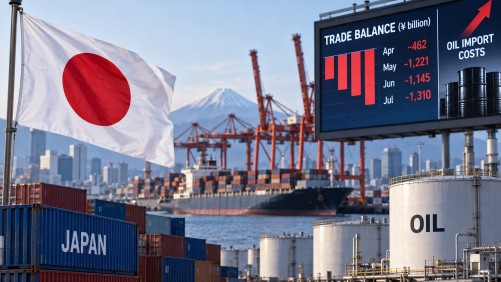
Japan’s ongoing struggle with trade deficits underscores a broader economic challenge, as August marked the fourth consecutive month of shortfalls for the nation. The country recorded a trade deficit of approximately 1.1 trillion yen, equivalent to $7 billion, primarily driven by escalating oil prices that have significantly inflated import costs. This development highlights the economic strain on Japan, which is heavily dependent on energy imports.
According to preliminary data from Japan’s Finance Ministry, imports soared by 28% compared to the previous year, reaching 11.15 trillion yen, or $71.9 billion. The surge in import costs is largely attributed to the rising energy prices, exacerbated by geopolitical tensions in the Middle East that have disrupted oil supplies and shipping routes, particularly around the critical Strait of Hormuz.
Despite the challenges on the import front, Japan’s export sector showed resilience. Exports grew by 19.3% year-on-year to 10 trillion yen, or $64.5 billion, bolstered by robust shipments of automobiles and computer chips. The increase in exports provides a partial counterbalance to the import-driven deficit, though it has not been enough to offset the overall shortfall.
Trade with major partners also reflected significant shifts. Exports to the United States rose by 24.9%, while imports from the US saw a dramatic increase of 55.2%. Meanwhile, exports to Europe grew by 11% with a corresponding 20.4% rise in imports. In contrast, trade with the Middle East experienced a decline, with exports falling by 5.2% and imports decreasing by 4.2%, as regional instability continues to impact trade activities.
The interplay of these factors presents a complex scenario for Japan’s economic landscape, where the balance of trade is heavily influenced by external energy market fluctuations and geopolitical events. The ongoing trade deficit highlights the vulnerability of Japan’s economy to external shocks, particularly in the energy sector, underscoring the need for strategic economic adjustments to mitigate these impacts.