
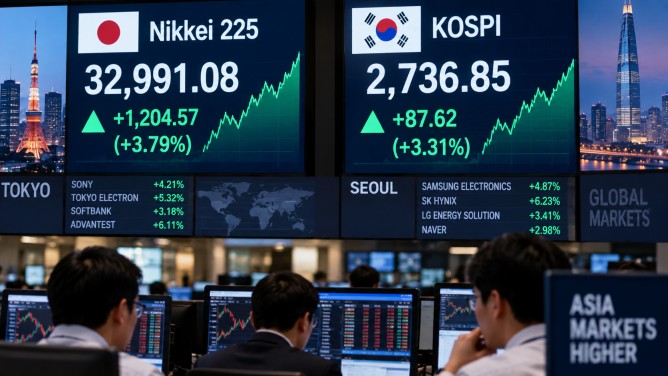
Asian stock markets surged on Monday, propelled by robust buying in technology and semiconductor sectors, with Japan and South Korea leading the gains. Japan’s Nikkei 225 experienced a significant rise of 2.1%, while South Korea’s Kospi saw an even more substantial increase of 4.6%. Notably, major semiconductor companies, Samsung Electronics and SK Hynix, recorded impressive gains of 5.7% and 8.1%, respectively. Other semiconductor-related firms such as Renesas Electronics, Rohm, and Tokyo Electron also enjoyed strong performance, reflecting sustained investor interest in artificial intelligence and semiconductor technologies.
In contrast, European markets displayed more restrained activity. France’s CAC 40 remained almost unchanged, and both Germany’s DAX and Britain’s FTSE 100 experienced slight declines. Meanwhile, U.S. stock futures suggested a weaker opening; however, U.S. markets were closed in observance of the Labor Day holiday, pausing any immediate impact.
Elsewhere in Asia, market trends varied. Hong Kong’s Hang Seng index fell by 0.9%, and China’s Shanghai Composite Index showed little movement. In Australia, the S&P/ASX 200 managed to achieve a minor gain, indicating a mixed regional performance.
The currency market also captured attention as the U.S. dollar weakened against the Japanese yen. This development has heightened concerns among Japanese policymakers, who are closely monitoring the situation for potential signals from the Bank of Japan regarding forthcoming interest rate policy. Concurrently, oil prices stayed high amid ongoing tensions between the United States and Iran, contributing to global inflation worries and economic outlook uncertainties.
Amid these market fluctuations, investors are keenly awaiting upcoming U.S. inflation data and the Federal Reserve’s policy meeting in September, as these are expected to provide critical insights into the future trajectory of interest rates.